Private Hearing Tests
A private hearing test with The Hearing Clinic goes beyond a standard hearing test. Appointments cost £265 and last 90 minutes – enough time for our clinical audiologists to build a complete picture of your hearing health, with clear results, honest advice, and a plan for next steps. No GP referral needed.
When did you last have your hearing properly tested?
Most people don’t think about their hearing until something changes – conversations becoming harder to follow, asking people to repeat themselves more often, or struggling in noisy restaurants or offices. By the time those changes are noticeable, they’ve often been developing gradually for years.
A full diagnostic hearing test at The Hearing Clinic costs £265 and lasts 90 minutes – enough time for our clinical audiologists to give you an accurate picture of your hearing health today, and a baseline to measure against in future. You’ll leave with clear results, honest advice, and a specific plan for next steps, whatever those turn out to be.

Significantly more thorough than a free high-street hearing test

Around 90 minutes – never rushed, never a conveyor belt

Clear results and a written report within [timeframe]

CQC-registered clinical audiologist – not hearing aid salespeople
Private hearing tests vs free hearing tests
Free hearing tests on the high street are not the same as a private hearing test. Here’s the difference in practice:
A high-street hearing test typically takes 15 to 20 minutes. Ours takes around 90 minutes, giving us time to understand your hearing history, lifestyle, and specific concerns, not just run through the tests.
High-street tests typically include pure-tone audiometry and little else. Our assessment includes video otoscopy, tympanometry, pure-tone audiometry, speech testing in quiet and in noise, and – where relevant – additional specialist tests. We test how you actually hear in real-world conditions, not just in a soundproofed booth with ideal conditions.
Our assessments are carried out by clinical audiologists – not hearing aid dispensers or healthcare assistants. The difference in training, scope and clinical judgement is significant.
At the end of your appointment, you’ll have a clear, explained set of results, a written report, and an honest discussion of what, if anything, we recommend. There’s no pressure to buy hearing aids, and we won’t recommend them unless we’re confident they’ll benefit you.
Our assessment is clinician-led – what we recommend is based entirely on your hearing health, not on what we need to sell that day.
What your private hearing test involves
Every diagnostic hearing test is tailored to your individual situation. A key part of your appointment is the time we spend understanding you – your hearing history, lifestyle, and the specific challenges you’re experiencing. This detailed case history is essential, as it guides which tests we carry out and helps us interpret the results accurately, rather than relying on a one-size-fits-all approach.
We then use carefully calibrated, state-of-the-art equipment to assess your entire auditory system – not just your ability to hear tones in a quiet room. This allows us to build a complete, clinically reliable picture of your hearing.
Depending on your history and how the assessment progresses, your audiologist may carry out some or all of the following:
Video otoscopy
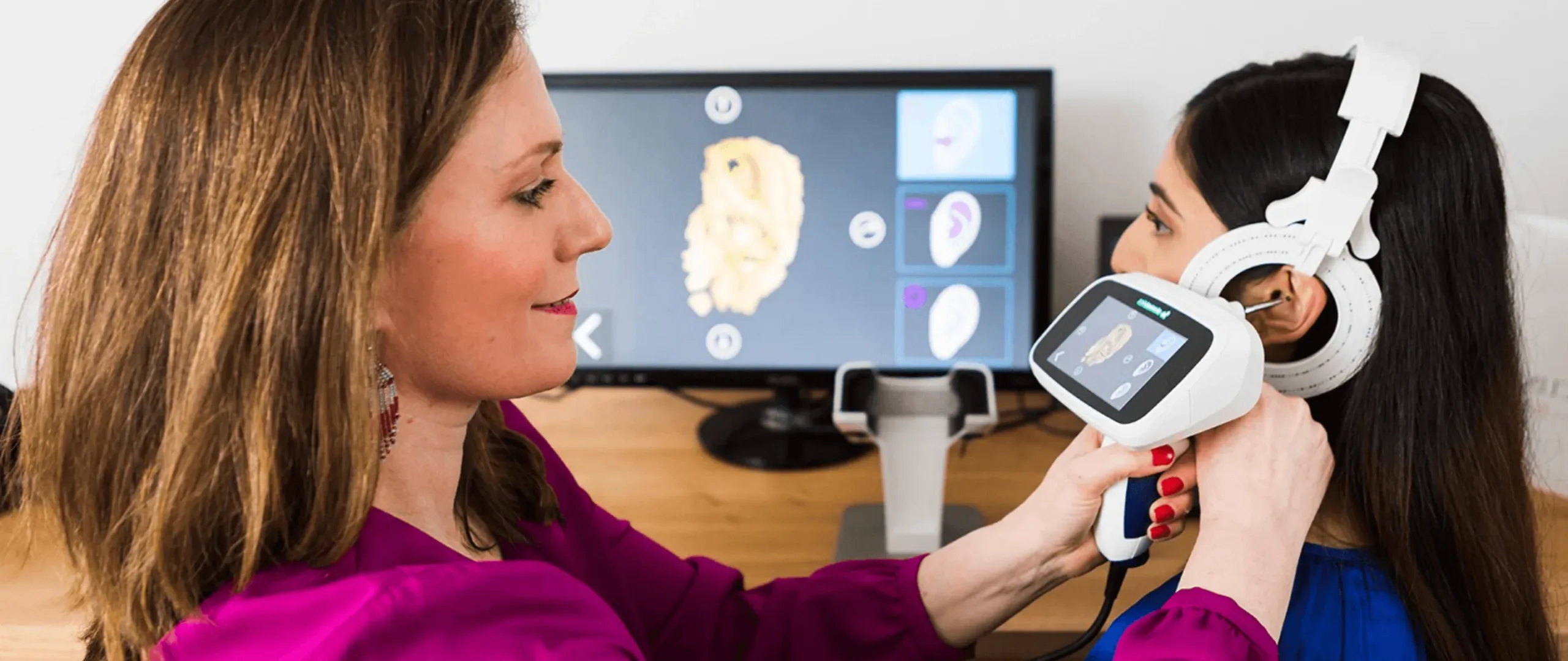
Before any testing begins, we examine your ear canal and eardrum using high-resolution video otoscopy. This allows us to clearly identify earwax build-up, infection, or structural issues that could affect your hearing or the accuracy of your results. You’ll be able to see exactly what we see on screen.
Tympanometry
This quick, painless test assesses how well your eardrum and middle ear system are functioning. By gently varying air pressure, we measure eardrum movement and the function of the tiny bones of hearing. This can highlight issues such as fluid, pressure problems, or middle ear dysfunction.

Pure-tone audiometry
The core hearing test involves listening to a range of tones at different frequencies and volumes. This creates your audiogram – a detailed map of your hearing. Unlike a standard high-street test, we take the time to ensure accuracy and consistency across both ears by testing your hearing in a soundproof booth.
Speech testing
Understanding speech is often the biggest real-world challenge. We assess how well you process speech both in quiet and in background noise, giving a far more realistic picture of how your hearing affects everyday life.
Otocoustic emissions (OAE)
This sensitive test measures how well the inner ear (cochlea) is functioning. It can detect subtle hearing changes that may not appear on a standard hearing test, providing an additional layer of diagnostic detail.
Real-ear measurement
If your assessment indicates that hearing aids would be beneficial, we use real-ear measurement to verify that they’re programmed precisely for your specific ear canal, not just your audiogram. A small microphone placed in the ear canal measures exactly how sound reaches your eardrum with the hearing aid in place, allowing us to fine-tune the prescription to the clinical gold standard. Many clinics don’t carry this out routinely – we consider it essential.
This is what one of our patients has to say about our hearing assessments:
“A life-changing experience”
As a teacher, my journey with hearing challenges began when I found myself struggling to hear my students in the classroom. Conversations in noisy environments like pubs and restaurants also became increasingly difficult. This prompted me to seek professional advice.
Before visiting the clinic, I had my reservations. I was particularly concerned about the idea of wearing hearing aids, worrying they might be uncomfortable or disruptive to my active lifestyle. My initial consultation was with a well-known high street provider. However, despite the friendly service, I felt the clinician lacked confidence about their knowledge about hearing loss and the available solutions. This led me to seek a second opinion.
The moment I stepped into the clinic, I was greeted with warmth and friendliness. The reception team put me at ease right away. Bridgitte, who handled my care, explained the testing process with remarkable confidence. The thoroughness and detail of the testing far surpassed my previous experience. Bridgitte took the time to discuss various products and options with me. She inquired about my lifestyle, work, and hobbies and ensured the hearing aids complemented my specific needs. She even guided me on setting up the functions on the app and patiently answered all my questions.
What to expect at your appointment
Before you arrive
No special preparation is needed. If you’ve had a previous hearing assessment elsewhere and have the results, it’s worth bringing them, but they’re not required. If you wear hearing aids already, please bring them with you.
In the appointment
Your audiologist will begin by asking about your hearing history, any specific difficulties you’ve been experiencing, your lifestyle, and what you’re hoping to get from the assessment. This conversation matters – it shapes which tests we run and how we interpret the results.
We’ll then carry out the relevant tests in sequence, explaining each one as we go. There’s no rush, and you can ask questions at any point.
At the end
We’ll go through your results with you clearly – what they show, what they mean for your daily life, and what, if anything, we recommend as a next step. You’ll receive a written report. If hearing aids are recommended, we’ll explain the options without any pressure to commit on the day.

Bringing someone with you
We actively encourage you to bring a partner, family member or friend. They often notice things that are harder to self-report, and having someone else hear the results and next steps can be useful.
What does a private hearing test cost?
An adult full diagnostic hearing test at The Hearing Clinic is £265. This includes a full appointment with a clinical audiologist, all relevant tests, a written report with your results, and a clear discussion of next steps. No GP referral is needed to book.

Unsure if you need a private hearing test? We can help
If you’ve noticed changes in your hearing – or someone close to you has – it’s worth getting it checked. Our team will answer your questions honestly and help you decide whether a diagnostic hearing test makes sense for you. Complete the form, and we’ll call you back.
"*" indicates required fields
Have more questions?
Don’t hesitate to contact us
We’re here to support you every step of the way. Whether you have questions about your hearing health, need help booking a private hearing test, or simply want to chat with our friendly team, we’re just a message away.
Most hearing loss develops gradually, which means many people adapt to it slowly without realising how much they’re missing. By the time it becomes noticeable to others, it’s often been present for years. A comprehensive hearing assessment gives you an accurate baseline and, if hearing loss is present, allows you to take action earlier, when the benefits of intervention are greatest. It also rules out any underlying issues that might need medical attention.
No, you do not need a GP referral for a private hearing test at The Hearing Clinic – you can book directly with us. If your GP has raised concerns about your hearing or you have relevant medical history, it’s helpful to mention this when you book, but a referral is not required.
Not at all. Every test we carry out – including tympanometry and pure-tone audiometry – is comfortable. The video otoscopy involves a small camera being gently placed at the entrance to your ear canal, which is entirely acceptable for the vast majority of patients.
A private hearing test at The Hearing Clinic takes around 60-90 minutes, though this can vary slightly depending on which tests are needed and how the appointment unfolds. We never rush – if something needs more time, we take it.
We’ll explain the type, degree and likely cause of your hearing loss clearly, and discuss the options available to you. This might include monitoring, hearing aids, referral to an ENT specialist, or other management strategies, depending on what we find. There’s no pressure to make any decisions on the day – we want you to leave feeling informed, not sold to.
If you’ve had a hearing test before and have the results, please bring them. We’ll review them alongside our own assessment. Many patients come to us after an NHS assessment when they want more detail, a second opinion, or a more thorough evaluation than time allowed for elsewhere.
That depends entirely on the type and cause of your hearing loss. Some types are stable; others progress over time. Some causes are treatable. The only way to know is to have a full hearing test, which is exactly why coming in sooner rather than later is always the right decision.
-

An amazing insight into what top level hearing care looks like. The hearing solution provided has been life changing.
DA
David

-
Always very professional and prompt service Everyone very pleasant Evironment very comfortable Recommend highly
AM
Anne-Marie Breen
-
I would totally recommend the hearing clinic. They are professional and very knowledgeable but also very friendly and easy to talk to.
LB
Linda Benton
-
Jo was both professional and understanding. She took so much trouble to get my microsuction right, ensuring I was comfortable throughout the process. I now have a much better understanding of my ears and of how to prevent wax building up in future.
RI
Richard
-
I highly recommend the hearing clinic at Harrogate. I was on holiday at the time but managed to get an appointment after suffering muddled hearing for a few weeks. I have had my ears syringed in the past but never micro suctioned, which turned out to be a painless procedure.
CD
Carolyn Dunn
-
This is my third set of hearing aids that I’ve purchased from them — something I wouldn’t do if I didn’t have complete trust in both the technology and the people supporting me. Each time, Claire has guided me towards the right choice for my needs, and the improvement in my everyday life has been remarkable.
WI
Wilson
-
On enquiry I received an appointment swiftly. The service offered was excellent and the practitioner informative, efficient and extremely pleasant. I have booked a further appointment and was extremely impressed with the service. Well done.
MC
Marjorie Cheryl
-
Very caring with my mother who has alzheimers and explained every stage of what was happening in an easy understandable way.
LA
Lee