

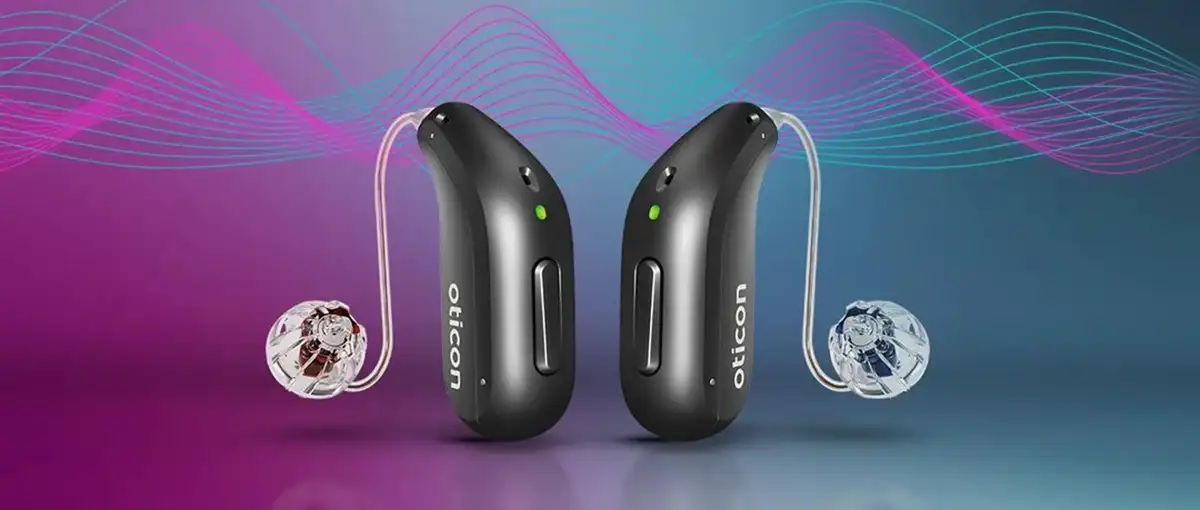
Two of the biggest hearing aid launches in years arrived within a week of each other: the Oticon Reveal and the Phonak EON Sphere. Since then, the question we hear most in clinic is a simple one. Which is better?
You’ll find plenty of reviews comparing spec sheets: channels, fitting ranges and battery life. They’re useful, but they don’t tell you what it’s like to wear a hearing aid over breakfast, chat to your partner in the evening or catch up with friends in a busy restaurant.
So we did something different. We put both hearing aids in real ears and measured what they actually delivered. Then we looked at the four things you’ll notice every single day:
- Your own voice: does it sound natural, or like your head is in a barrel?
- Whistling: and the hidden cost of stopping it
- Clarity: does the hearing aid actually reach your prescription?
- Natural sound: does the room still sound like a room?
The short answer: on an open fitting, the Oticon Reveal reached the full high-frequency prescription. The Phonak EON Sphere fell short above 2000 Hz. But that’s not the whole story, and the right choice depends on your ears, not the brochure.

First, why the “beep test” isn’t enough
Most people know the standard hearing test. You sit in a soundproof booth and press a button every time you hear a beep. It’s important, but it tells us very little about how your brain processes the sounds of everyday life.
If your hearing care professional relies on the beep test alone, they may not know enough about your hearing to recommend the right hearing aid. And as you’ll see, these two hearing aids suit quite different people.
Two hearing aids, two very different philosophies
Imagine you’re sitting in a crowded café. A friend sits opposite you, chatting away. Around you there are other voices, background music, the clatter of cups and the hum of traffic outside.
Your brain has to sort that jumble into something meaningful: which voice is your friend’s, which sounds are just background, and which might need your attention. Two auditory skills do this work, and each hearing aid is built around one of them.
Oticon Reveal: keeping the whole scene (auditory scene analysis)
Auditory scene analysis is your brain’s way of organising that “soup” of sound into separate streams, building a 3D picture of the world around you.
Oticon argues that many hearing aids have made this harder by focusing so hard on speech that they strip away the surrounding sound. You lose the clues that tell you where you are, and the feeling of being present in the room.
The Oticon Reveal uses two AI systems working side by side. Speech AI processes the voices, and Context AI processes the sounds around them. The hearing aid keeps the two in balance, so speech always sits just above the background.
Phonak EON Sphere: pulling one voice forward (auditory figure-ground)
Auditory figure-ground is your brain’s ability to focus on one voice while pushing everything else into the background. A typical hearing brain does this beautifully.
That’s exactly the job of the Phonak EON Sphere’s dedicated speech-in-noise processor. It identifies speech, untangles it from the noise, cleans it up and delivers it clearly, while turning the background right down.
A word of warning: untreated hearing loss can weaken both of these skills over time. The longer it’s left, the harder background noise becomes. Even a mild hearing loss is worth treating early.
Can you bear to wear them? Occlusion and your own voice
Let’s start with the most important question of all. If you can’t bear to wear your hearing aids all day, you’ll never benefit from the clever technology inside them.
Part of every hearing aid sits in your ear canal. At one end, a soft open dome barely blocks the ear at all. At the other, a custom earmould seals the canal almost completely. And then there’s everything in between.
When you speak or crunch on toast, those sounds travel through the bones of your head and normally leak straight out of your ears. Block the ears, and they become trapped. This is called the occlusion effect, and it can be horrible. Suddenly your own voice sounds hollow and boomy, as if your head is in a barrel.
Not everyone is bothered by it. It depends on your low-frequency hearing, around 250 and 500 Hz on your audiogram:
- Better than about 40 dB in the low frequencies? You’re much more likely to struggle with occlusion, so an open fitting usually feels best.
- Hearing loss greater than about 40 dB there, or a moderate to severe loss? Occlusion is far less likely to bother you.
Why hearing aids whistle, and the hidden cost of stopping it
Here’s the catch. An open fitting lets your own voice escape, but it also lets amplified sound escape. When that sound leaks out and is picked up again by the microphone, the hearing aid whistles. We call this feedback.
The biggest cost of feedback isn’t the whistle. It’s what the hearing aid does to stop it. The simplest fix is to quietly turn down the high frequencies, which is exactly where the consonants of speech live. Those consonants are what make speech clear.
You may never hear your hearing aids whistle, but you may never get the clarity you need either. How well a hearing aid controls feedback decides how much of your prescription you actually receive.
Our real-ear test: Oticon Reveal vs Phonak EON on an open dome
So we put both to the test. We took a typical high-frequency hearing loss with fairly good low-frequency hearing, the kind we see every day in clinic. This person can hear the low speech sounds, but the higher consonants such as “s”, “f” and “th” are out of reach.
We fitted both hearing aids with an open dome. Then we used probe microphone (real ear) measurements, a thin tube placed in the ear canal, to measure exactly what each hearing aid delivered against the prescription target.
The result:
- Oticon Reveal reached the full high-frequency amplification this hearing loss needed.
- Phonak EON Sphere fell short above 2000 Hz. That means less access to the consonants, and less clarity for speech, on an open fitting.
For this type of hearing loss, with a comfortable, open fit, the Oticon Reveal was clearly the better performer.
So is the Phonak EON Sphere the loser? Not at all
To give the Phonak EON Sphere the same high-frequency amplification, we need to close the ear canal and cut off that leakage pathway. For anyone with more than about 40 dB of hearing loss in the low frequencies, that’s rarely a problem.
In fact, a closed fitting or custom earmould is the key that unlocks the Phonak EON Sphere’s magic. The seal allows more amplification without whistling, and it shields your ears from much of the background noise. That leaves the hearing aid free to do the heavy lifting: pulling out the speech and delivering it cleanly.
The noisy café test: which is better in background noise?
Back to that busy café. This is where the difference between the two really shows.
Wearing the Phonak EON Sphere, you’ll notice its Spheric Speech Clarity straight away. The noise drops back and your friend’s voice steps forward. Phonak says it can improve the balance of speech over noise by up to 10 dB. In real life, that can be the difference between straining for every word and simply relaxing into the conversation.
Wearing the Oticon Reveal, the café is still there. You can hear the bustle, the music and the laugh at the next table. But your friend’s voice sits just above it all, so you hear them clearly within the whole soundscape.
So which is better? Honestly, it depends on you. Some people are still good at picking a voice out of noise, as long as the sound reaching them is clear. For others, that skill has faded and everything blurs together.
Does the world still sound natural?
Naturalness ties everything together. It comes from how your own voice sounds, how crisp the high frequencies are, and whether the room still feels like a room.
It’s also shaped by your degree of hearing loss, the dome or mould you wear, how accurately the hearing aids are programmed, and how well your brain adapts. In other words, the same hearing aid can sound wonderful on one person and wrong on another.
Oticon Reveal or Phonak EON Sphere: which suits you?
| You’ll probably prefer the Oticon Reveal if… | You’ll probably prefer the Phonak EON Sphere if… |
| Your low-frequency hearing is fairly good and your loss is mainly in the high frequencies | You have a more significant hearing loss across the frequencies |
| You want an open, comfortable fit and a natural-sounding voice | You can tolerate a degree of occlusion, or are happy to wear a custom earmould |
| You like to stay aware of everything going on around you | Noise tires you out or overwhelms you |
| You want hearing aids that feel less like hearing aids | Picking out one voice in a noisy room has become hard work |
The Oticon Reveal is built around naturalness. For many people it feels less like wearing hearing aids and more like simply hearing.
The Phonak EON Sphere, especially in its speech-in-noise mode, can create a calm bubble in a loud room, where you can relax and join in.
Both are excellent hearing aids. Neither is the right choice for everyone.
The most important part: your audiologist
The hearing aid decides what’s possible. Your audiologist decides whether you ever get there.
At The Hearing Clinic, that means:
- A full two-hour hearing aid assessment that looks at your whole auditory pathway, not just the beep test.
- Understanding your life: your work, family, hobbies and the places you struggle most.
- The right fit in your ears, choosing the correct dome or a custom mould.
- Precise programming with real ear measurements. Without them, settings are largely guesswork and rarely optimised for you.
- Aftercare and rehabilitation. Your brain needs time and support to adapt, so follow-ups and fine-tuning are part of the journey.
Frequently asked questions
Is the Oticon Reveal better than the Phonak EON Sphere? Neither is better for everyone. In our real-ear test on an open dome, the Oticon Reveal reached the full high-frequency prescription and the Phonak EON Sphere fell short above 2000 Hz. With a closed fit or custom earmould, the Phonak EON Sphere’s speech-in-noise processing comes into its own.
Which is better in background noise? The Phonak EON Sphere pulls one voice forward and pushes noise back, which suits people who find noise tiring. The Oticon Reveal keeps the whole scene and lifts speech just above it, which suits people who like to stay aware of their surroundings.
Which is best for high-frequency hearing loss? If your low-frequency hearing is good and you want an open fit, the Oticon Reveal had the edge in our testing because it controlled feedback without giving up high-frequency amplification.
Why does my voice sound boomy with hearing aids? That’s the occlusion effect. Sounds from your own voice are trapped when the ear canal is blocked. A more open fitting usually helps if your low-frequency hearing is fairly good.
What are real ear measurements? A thin probe tube in your ear canal measures exactly what your hearing aid delivers, so your audiologist can match it to your prescription rather than guessing.
Don’t just take our word for it. Hear it for yourself
We’re hosting Listening Days in Hitchin on Wednesday 18 and Wednesday 25 November 2026. You’ll wear the Oticon Reveal or the Phonak EON Sphere in a real, busy café, programmed to your own hearing with real ear measurements. If you can’t decide which to invest in, this is the event for you.
Find out more and book your place
Or if you’d like to start with the full picture of your hearing, book your two-hour hearing aid assessment at our Hitchin, Welwyn or Radlett clinics.
Hitchin 01462 506074 · Welwyn 01707 594979 · Radlett 01923 372101
This article is general information, not personal medical advice. The Hearing Clinic supplies and fits both hearing aids featured..