


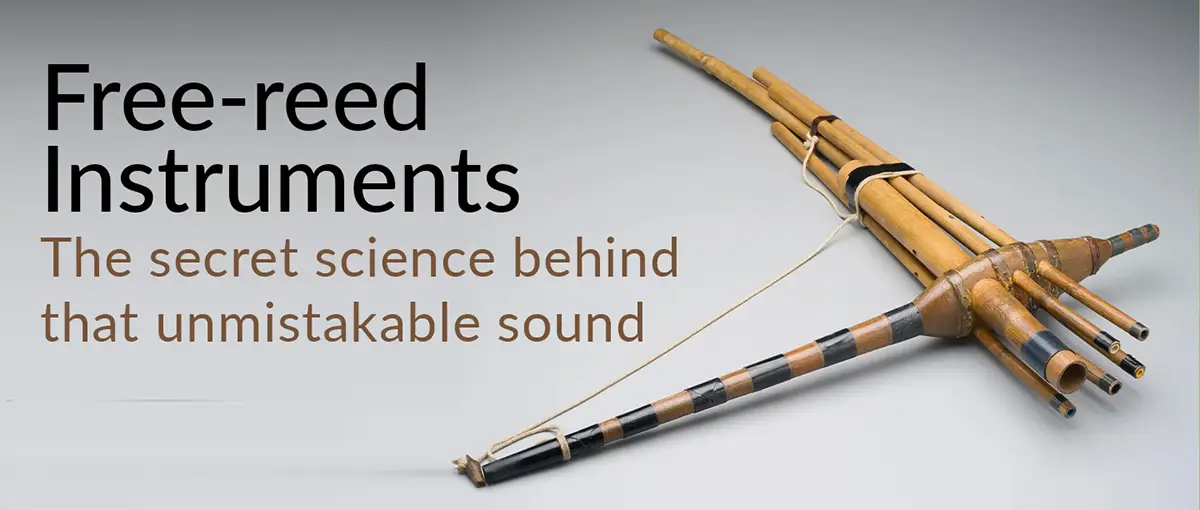
There’s a family of instruments whose sound you recognise straight away — think harmonica’s bluesy wail, accordion’s warm hum or the delicate glow of a Chinese sheng. These are free‑reed instruments, and a thoughtful review in Acoustics Today (Braasch & Cottingham, 2023) peels back the acoustics to show why they’re so sonically distinct.
What are free reeds?
A free reed is a tongue of material that swings through a frame to interrupt airflow, producing pulses of sound — rather like a tiny siren at work. Unlike beating reeds (think saxophone) or double reeds (oboes, bassoon), free reeds can produce rich tone clusters and lots of high harmonics that give them their “full” or sometimes “edgy” character.
East vs West — a small build, big difference
One neat finding: Asian and European free‑reed designs differ in where the reed sits relative to its frame. Asian reeds are cut in plane with the frame and usually need a resonator (a pipe or a player’s vocal tract) to sound; Western reeds sit above the frame and can sound on their own. That small construction tweak changes everything — how the instrument is played, whether it’s polyphonic, and how its pitch is controlled.
Why they sound like they do
Free reeds often produce a near‑square waveform with strong higher harmonics and a distinctive onset: the fundamental emerges first, with upper harmonics joining in slightly later. Peak frequencies fall where our ears are sensitive, which is also why reed choices and resonators matter so much for tone and expressiveness.
Everyday takeaways
- Love an instrument’s impact sound? That’s often by design: makers tune materials and shape to create a pleasing “attack.”
- Asian mouth organs (sheng, khaen) use resonators and finger holes to change pitch; Western instruments (harmonica, accordion) rely on sets of reeds for each note.
- Modern tweaks and hybrids keep appearing — players and makers are still exploring the expressive possibilities.
Source: Braasch J., Cottingham J. P. Free Reeds: An Intertwined Tale of Asian and Western Musical Instruments. Acoustics Today, Winter 2023;19(4). doi:10.1121/AT.2023.19.4.14